
How to Set Realistic Goals for Your Writing
Momentum isn’t something you passively wait for; it’s something you actively build through small, consistent actions, even on days when your document feels burdensome compared to your motivation. As we enter March, this post is about transforming the ideas you’ve been holding onto (chapter outlines, partial drafts, and quiet aspirations) into sustainable actions. Completing a thesis or dissertation isn’t achieved through sudden bursts of effort; it requires setting realistic, compassionate goals that fit your current lifestyle. Today, we focus on how to establish these goals with clarity and confidence, enabling you to progress without risking burnout. And if perfectionism or imposter syndrome is creeping in, momentum has a way of cutting through the noise.
Last month, I posted a brutally honest writing flowchart. In that post, I try to dispel the myth that writing has a perfect plan. Graduate students are often told—explicitly or implicitly—that if they could find the right system, schedule, or burst of inspiration, everything would finally click. But dissertation momentum doesn’t come from intensity or from waiting for the stars to align; it comes from showing up in small, consistent ways, even when the work feels uneven or imperfect. Progress that looks messy still counts, and it’s often the only kind we get, which can be reassuring for those feeling overwhelmed by perfectionism.
Before you can set meaningful goals, you need a clear picture of your actual starting point. Not the version you wish were true, not the one you think your advisor expects, not the one you tell them is true, and not the one you imagine everyone else has already achieved. Take stock of what’s drafted, what’s half-formed, what’s still in your note’s app, and what you’ve been avoiding because it feels too big or too unclear. This isn’t about judgment; it’s about orientation. When you know where you’re standing, you can finally decide where to step next. If your next step is to visit seven different archives, but you can only afford to visit three or five, map that out, see what works for you, and go from there. Depending on your timetable, you may be able to get grants for the different places. If you are up against the clock, which archives will yield the most information?
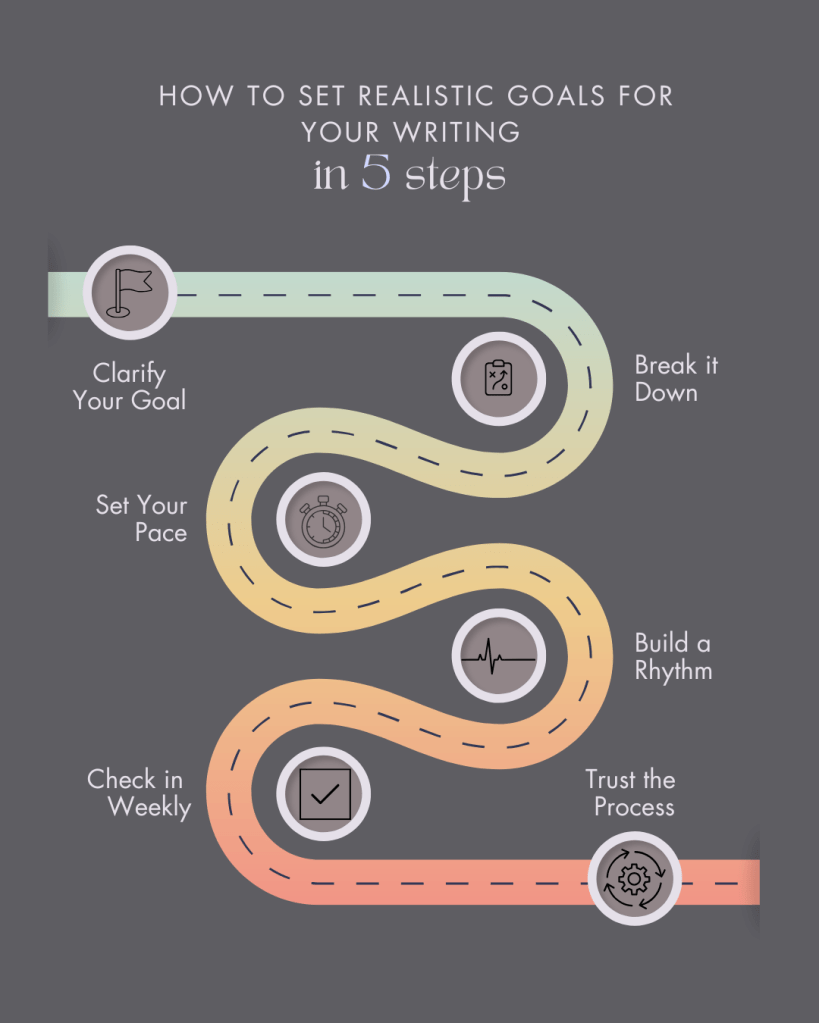
Once you know where you’re starting, the next step is to set goals that fit the life you’re living. Again, no idealized versions or imaginary timelines. Adapting a timeline is great, but it needs to start with you. Realistic goals are specific, measurable, and small enough that you can meet them on an ordinary day, not just a perfect one. If you teach two courses and bartend at night, when can you write or when can you take that archival trip that you’ve saved for? The next step can be committing to 300 words instead of 1,000, revising one subsection instead of an entire chapter, or choosing three sources to annotate instead of “catching up on the literature.” It can also mean creating a savings timeline to ensure you get everything done. If you find yourself stuck and can’t read a paper, annotate a book, or write 300 words, find something you can do. What is in your reach that will allow you to go from step one, onto step two, and then on the path to step three? The point isn’t to shrink your ambition; it’s to create goals you can return to consistently. Momentum builds when your goals are doable, repeatable, and honest about your bandwidth. The recommendation is to do something daily. What if that doesn’t work for you, say you have kids and a full-time job? Find a way to give yourself a few hours here and there each week. If you can’t do it daily, that is okay!
When your goals finally feel realistic, the question becomes how to make them doable. That starts with breaking them down. Once you have goals and the time to pursue them, break them into micro-tasks. Micro-tasks build momentum by giving you quick, repeatable wins that make it easier to keep moving. If you are going to commit to 300 words a day, think about the process. How can you make it achievable. If you thrive on small wins, reward yourself.
Once you’ve figured out your tasks, the next step is to create a weekly rhythm that helps you reach them. It doesn’t have to be a strict schedule or some elaborate, color-coded calendar—just a straightforward plan that keeps you on track. And hey, I’m not knocking on those who love color-coding! My calendars, notebooks, and everything is coded. Your next step is to focus on broad categories and not fixed hours. Think about a loose schedule with writing, research, and rest days. A writing day could be two hours before teaching or three on Tuesday morning. Research days might involve an afternoon at the library or a quiet morning with your sources. And rest days are just that, recharging time. Don’t overfill your day; you need shape to the week, but scheduling every hour of the “working day” leads to burnout. Choose two or three days when writing feels realistic. Pick one or two for research or reading. This rhythm becomes the scaffolding that holds your momentum and keeps you going. The goal is not perfection; it’s to find what works for you, so you don’t give up by Thursday.
With your weekly rhythm in place, the final step is learning how to adjust it when real life inevitably disrupts your plans. You can skip the steps for that week, add on where it makes sense, or move on. Pick back up the following week or find a new rhythm. What you shouldn’t do is work on your rest day. Think about how you want to track your progress so you can see what works. You can track your progress in whatever format feels natural: a simple checklist, a short weekly reflection, a journal entry, or a running progress log. Think of it like a brief update you’d give an advisor. You’re not sending it to anyone, but you are checking in with yourself. The goal is awareness, not judgment. If a week falls apart or the rhythm doesn’t hold, don’t beat yourself up. Notice what happened, adjust, and keep going.
Start small, stay consistent, keep checking in with yourself, and you’ll get there.

 Wendi Kavanaugh
Leave a comment