
How I Approach Research
Entering an archive always feels like crossing into another world that is part sanctuary, part maze. There’s a quiet thrill of possibility, the sense that something extraordinary might be hidden in the next box. The familiar overwhelm of fluorescent lights, strict rules, and the sheer volume of materials all remind me of my first visit to a public library, where I was often “shhhhed.” Archival research is both captivating and frustrating, and I’ve realized that the only way to stay centered in that tension is to depend on a system rather than the illusion of perfection. What follows isn’t a strict formula but rather a rhythm: the habits, boundaries, and small rituals that keep me curious, grounded, and sane as I navigate the chaos of the stacks.
Before I enter the reading room, I try to think about what question I am pursuing and what I believe I’ll discover. That small act of clarifying my purpose keeps me from wandering aimlessly or, worse, drowning in possibilities. Because I completely drowned during my first visit to the archives. It wasn’t pretty, but I went back to my hotel and figured out where I went wrong. I created a plan on paper since you could only have paper, pencils, and certain cameras (I used my smartphone). The second archive I visited only allowed paper. I had a form and could request copies that would be sent to me upon payment receipt. I reevaluated what I needed most rather than aimlessly looking at every folder in a box to find something useful. To be fair, I found a ton of amazing details during that visit, most of which did not make it into my dissertation.
Other factors to consider include time. How long can you stay each day? When does the staff require you to leave for lunch? When can you return? How long does it take the archive to find the box? (This is important at all libraries and archives.) How long can you stay? If you have a day, you won’t finish every box with 20 folders if you examine every page in each folder. Think about what you will take notes on versus what you will snap photos of to organize later. Your first day or even your first trip shouldn’t involve rabbit holes; build that time in at the end. Don’t pursue what you can’t use if you’re pressed for time. What rabbit holes I’m not allowed to chase yet. It’s less about discipline and more about creating a plan.
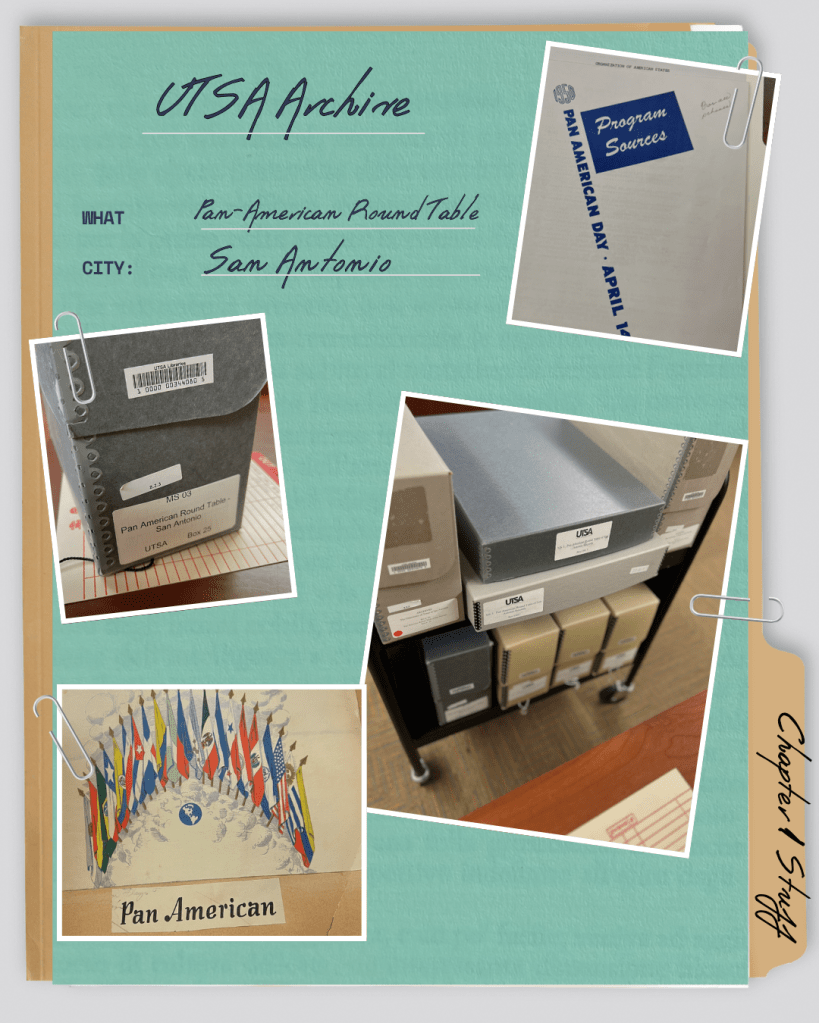
Before visiting, review the web pages about visiting procedures, as they may need a couple of days to pull requested boxes and have restricted hours. Archivists are there to help, but their primary responsibility is to protect their collections. Being courteous and understanding their rules is important. If you’re short on time and their hours don’t fit your schedule, avoid requesting extra time at the library. Instead, figure out a way to move your time around. I recommend checking out the ‘Guide to Archival Resources’ at UT San Antonio Libraries Special Collections for helpful guidance.
Inside the archive, my first hour is all about settling in: scanning the room, learning the rules (since they may not all be online), and easing into the rhythm of boxes and folders. From there, I move through the material with a simple triage system: —what deserves a deep read, what gets photographed, and what can wait. I would like to say my notes are steady and logical, but that’s a lie. I recommend taking notes if you need to: a descriptive line about what the document is, a brief analytical note on why it matters, or a thread that ties it back to your project. I take all the photos, starting with the box first, then the folder, which acts as a reset to the section when I download them. Make sure you can read the folder name if you are going to snap now and read later!
How do you know when or where to stop? This relates back to your pre-planning and avoiding rabbit holes. Get what you need, then check what’s in the other boxes or folders (if available). I create a need for this and do just that, then stop. When I’m in research mode, I try to avoid looking at things I can use later. While it’s fascinating, it can derail your visit. If you are a historian, you’ll understand that rabbit holes are the best part of research, but they also hurt us later when we could have used that time for something else.
I love archival work, but to be fair, I worked in a museum and often wonder why I didn’t major in Library Sciences (with a PhD in rare botanical books like this). Engaging with archival materials refines my research identity by prompting me to clarify what matters, question my assumptions, and embrace interpretive work. The archive helps reveal my habits, test my instincts, and guide me toward a more intentional and grounded practice.

 Wendi Kavanaugh
Leave a comment