
A review of Thinking About History
This book has sat on my shelf for years and even accompanied me on a runcation once, but I never committed to reading it. I finally decided to pick it up to review it for my blog. This book is a fantastic look at how historians think about or question history and why that matters.
Title: Thinking About History
Author: Sarah Maza, PhD
About the Author: Maza is a French Historian who spent her career at Northwestern University. After spending most of her career researching and publishing on French histories, she moved to writing on historical thought.
Genre: History
Sub-genres: Academic, Academia, Research, Nonfiction, Historiography, Methodology, Grad School, Theory
Core Takeaways: History, as a discipline, is really about ongoing, lively debates.
Appeal to me: Reading about history and seeing if I learn anything new.
Appeal to me for you: History is a debate from which you should learn or be a part. If you are a historian, you are part of history—you shape it.
Should you read this book? It depends on where you are in your career and what you study. The book is not for everyone. It is for those who want to teach history or to understand the landscape of history.
Rating: 3.75/5 (maybe 4/5 for new historians)
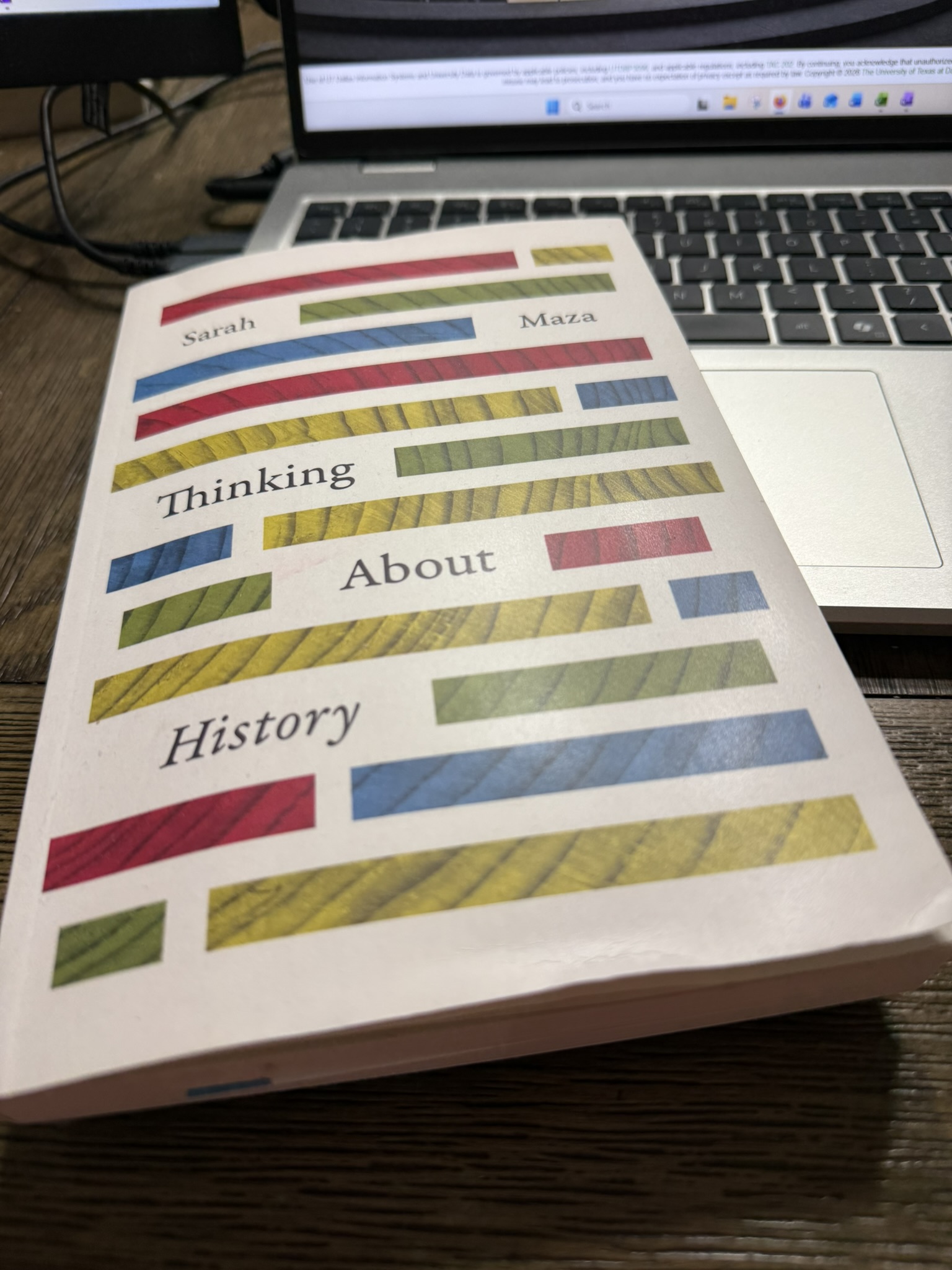 As someone who works with students and colleagues across subfields, I appreciated how Maza positions history as both deeply rigorous and inherently interpretive. It’s a balance that many introductory texts struggle to strike. Maza shows that history is both rigorous and interpretive—a balance most introductory texts miss. Thinking About History refreshed my understanding of the field’s foundations. Rather than instructing you on what to think, the book shows how historians have debated and revised their work. It invites you to join that ongoing conversation. I annotated this book extensively, as I typically do with nonfiction works. Here are some of my favorite quotes.
- “What historians do, while it may see obvious, proves surprisingly hard to define once you start thinking about it.”
- “History is not only the ultimate hybrid field, borrowing its languages and methods from both the social sciences and the humanities; it is also the discipline that most frequently crosses over from the academic world into the public sphere.”
- “Historians begin with no such object; their task consists in creating, through research, the thing that they work on.”
I gave this book a 3.75 out of 5 because it’s very niche. If you are a historian, it’s a great read. If you are later in your career, it will not be groundbreaking or even new ideas. If I were to use this book, I would start the semester with it, possibly in a graduate-level course. I could see using this book in courses titled: “Researching History: Approaches, Evidence, and Interpretation,” “History About History: Historiography and the Craft of Interpretation,” or even a super simple title of “Understanding History.” The book is organized around six big questions, each designed to spark discussion rather than provide a single answer. It’s easy to imagine assigning a chapter and watching students immediately latch onto the examples Maza uses to illustrate abstract ideas. This book is perfect for a month focused on research and historical thinking. It feels thoughtful yet straightforward, organized but open to new ideas, and genuinely connected to the discipline’s potential.


Leave a Reply