
OR Go Back the Basics: a review of Several Short Sentences About Writing
I wanted to create a space for ideas and resources in academia. I finished my PhD in December 2025 and had so much to share! I’ve also spent the past 10+ years as a director at a university honors college. I chose monthly themes that could easily span my social media platforms (all two of them – this blog and my Instagram). I love reading and learning, so I thought I would do at least one book review a month. For this month, on writing, I selected something slightly off-topic. In fact, the book was not necessarily about writing nonfiction, essays, or trying to finish a degree. The Anatomy of Story: 22 Steps to Becoming a Master Storyteller by John Truby is amazing! I quickly realized last weekend, when I started reading the book, that I would not finish it by today’s posting time!
I opted to take the time with Truby’s book. The book was so inspiring that I decided to stop for now and pick it up later, when I had time to do the recommended practices. Don’t worry, I’ll come back to this book later! By Monday night, I knew I needed a short book I could finish in a day or so. So, I downloaded Several Short Sentences About Writing.
Title: Several Short Sentences About Writing
Author: Verlyn Klinkenborg, PhD
About the Author: Klinkenborg holds a PhD in English Literature and has previously taught both creative writing and literature at several universities, including Fordham, Harvard, and, currently, Yale. He is also a lecturer of Forestry and Environmental Studies. He has written several books and articles for Harper’s Magazine, Mother Jones, and others. He also served as an editor for The New York Times.
Genre: Writing
Sub-genres: Nonfiction, Craft, Reference, Language, Essays, Education, Teaching
Core Takeaways: Write short sentences, and understand what you are trying to say. There is nothing wrong with starting off simply.
Appeal to me: I love reading about writing! I love soaking in new tips! I’m a storyteller at heart, so anything that makes me better appeals to me as a reader and lifelong learner.
Appeal to me for you: It doesn’t matter how you feel about your writing; this book will teach you to start simple and believe in your sentences, one word at a time.
Should you read this book? Yes, you can finish it in a few hours!
Rating: 4.5/5
In this book, Klinkenborg challenges you to unlearn your complicated English lessons and relearn how to create short sentences. This book challenges what you should do as a writer. A writer of any type – a fiction writer, a professor, a student, or someone on social media. Think about the words, then create a short sentence. If you write a long sentence, how can you break it up? Short sentences are not bad and do not mean you aren’t trained or professional. It simply means going back to learning how to write.
This is one of the best points in the book. Do you learn to write, or do you learn to read? I will admit it was very hard not to combine those three sentences. That is part of the challenge set forth in the book: unlearning what you think you should do to sound intelligent. You will need practice to do this; it’s not natural, as Klinkenborg tells us, “Talking is natural. Writing is not (71).” Stop and re-read that out loud. Writing is not inherently natural. You must work at it. Do you have time to practice? Sure, why not? You can text short sentences to your best friend, dad, or colleague. Why not stop now and send a short sentence about this post to a friend? “Practice, And you’ll learn to trust the agility and capacity of your thinking, (92).” How on earth do you do any of that? It takes practice. The first 80-ish percent of the book is written in simple sentences with no paragraphs. I loved this so much! According to my Kindle, I highlighted 55 passages. That may not seem like a lot, but the book is 206 pages and very spaced out, as you can see below.
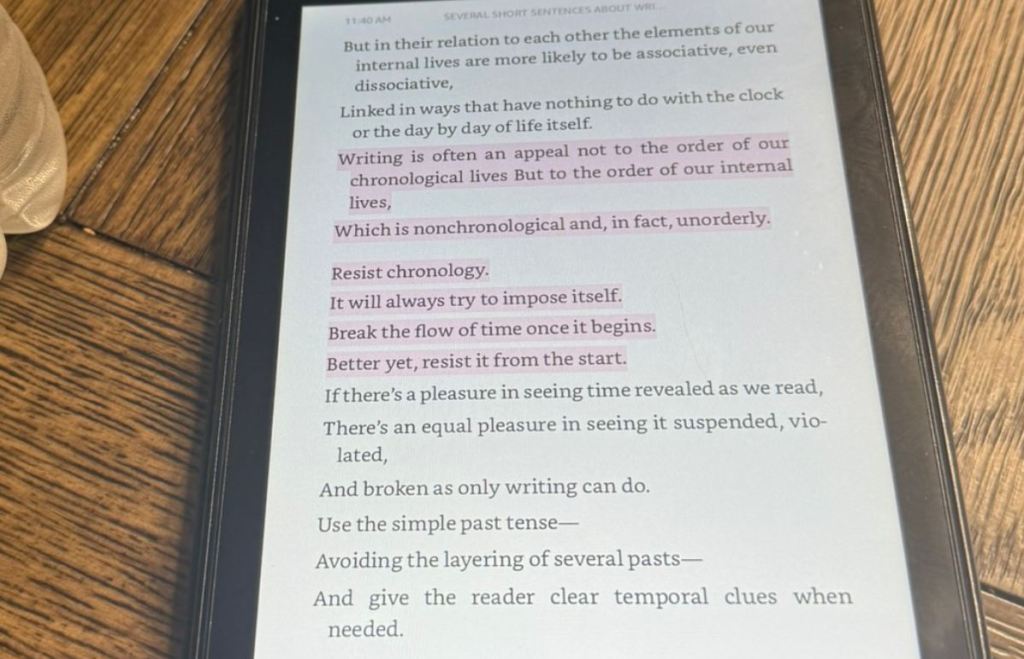
As you can tell, I loved this short read and learned so much from it. Why then did I not give it 5 stars? The book changes format around page 150. A new section titled “Some Prose and Some Questions” begins. Klinkenborg provides several short prose pieces to illustrate his points. While I appreciate this, it did not resonate as strongly as he probably intended. After the prose, he explains why and how to review the pieces – as any good professor would! He does hook me again with the final section, “Some Practical Problems.”I loved taking a single sentence and seeing how it could be improved! When I read that, I thought I would be asked to fix a sentence. I was delighted to see the problems:
The Lincoln-Marti School resides in Little Havana, Miami. “Resides”? The author is clearly trying not to use “is.” But why? It’s simple and economical and doesn’t make the reader feel as though the Lincoln-Marti School had retired to Florida (189.)
Los Angeles is the largest city in California with a population of over 4,997,340 spanning 498 square miles. What does this sentence actually say? That of all the cities in California with a population of over 4,997,340 spanning 498 square miles, Los Angeles is the largest, somehow. Again, the word “with” is the culprit. A comma after California would help, but the sentence would still be weak syntactically. “With” is not remotely strong enough to sustain a sentence like this (192).
Honestly, this book is worth the time and money you spend on it. I hope you enjoy it as much as I did! If you do read it, let me know what you think of the prose section. I hope I didn’t ruin it for you!


Leave a Reply